
case study
Progress Scanning a Toronto Restaurant Build for Shareholders Abroad
How we used multi-phase 3D scans to give Bar Buca's absentee stakeholders an on-demand window into a restaurant construction project on Eglinton. A field-notes case study on commercial progress documentation.
Ravi Mundi
Founder · June 19, 2026
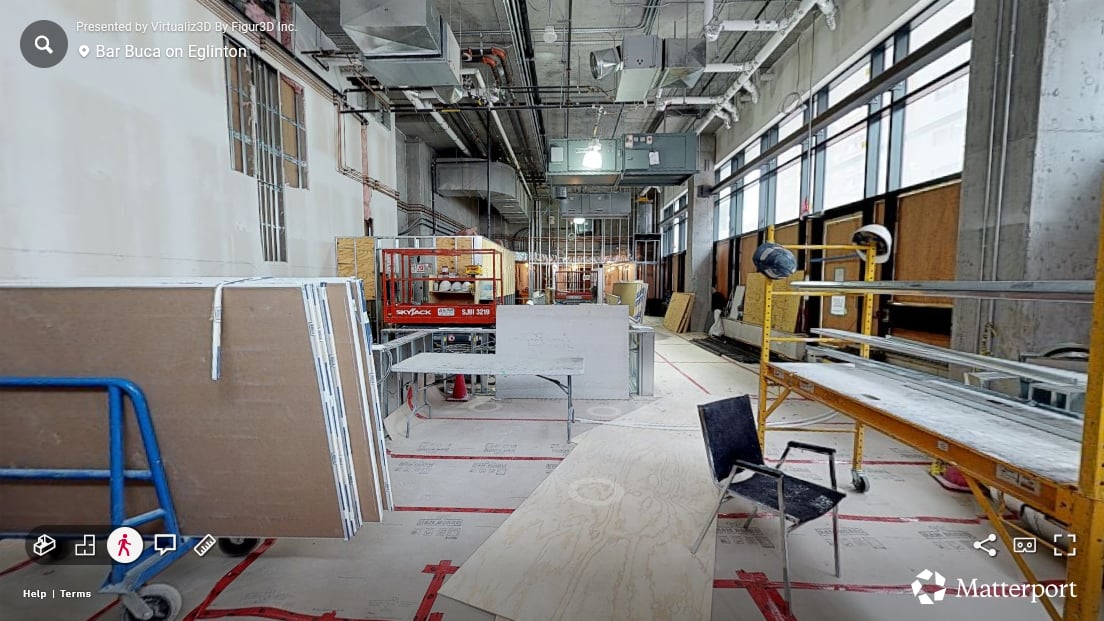
When stakeholders or owners live abroad, every photo of the construction site is a partial answer to a question they didn’t get to ask. Written reports describe progress. Photos show fragments. Neither lets a stakeholder check. For Bar Buca’s new Eglinton location, the team behind the build wanted absentee shareholders to see the site the way someone walking it would. Multi-phase progress scanning solved it.
The build — a new restaurant on Eglinton
Bar Buca opened a new location on Eglinton in midtown Toronto. The shareholders and ownership were based outside the country during the construction phase — unable to walk the site, but expecting regular, detailed updates on how their investment was progressing. The project budget was real, the timeline was real, and the build involved the usual dozens of weekly decisions a commercial fit-out requires.
The team needed a way to keep shareholders genuinely involved without flying anyone in.
Why scans, not photos
A photo update is a partial view. The framer picks an angle, takes a shot, sends it. The stakeholder sees what’s in frame. Anything outside the frame — the routing of a service that’s going to be sealed behind drywall, the layout of the kitchen island as it’s being staked, the relationship between the bar back and the cooler line — is invisible until someone thinks to photograph it.
A 3D scan is the opposite. The scan tech sets up at every vantage point in the building and captures 360° at each. The stakeholder gets to choose what to look at. They can walk the building from anywhere in the world, look at the kitchen rough-in from one angle and the bar layout from another, and they can do it on their schedule, not the schedule of whoever is sending them updates.
Two scans, two milestones
We captured Bar Buca twice during construction. Same building, same vantage points each time, so the second scan is directly comparable to the first.
Scan one — early framing and mechanicals
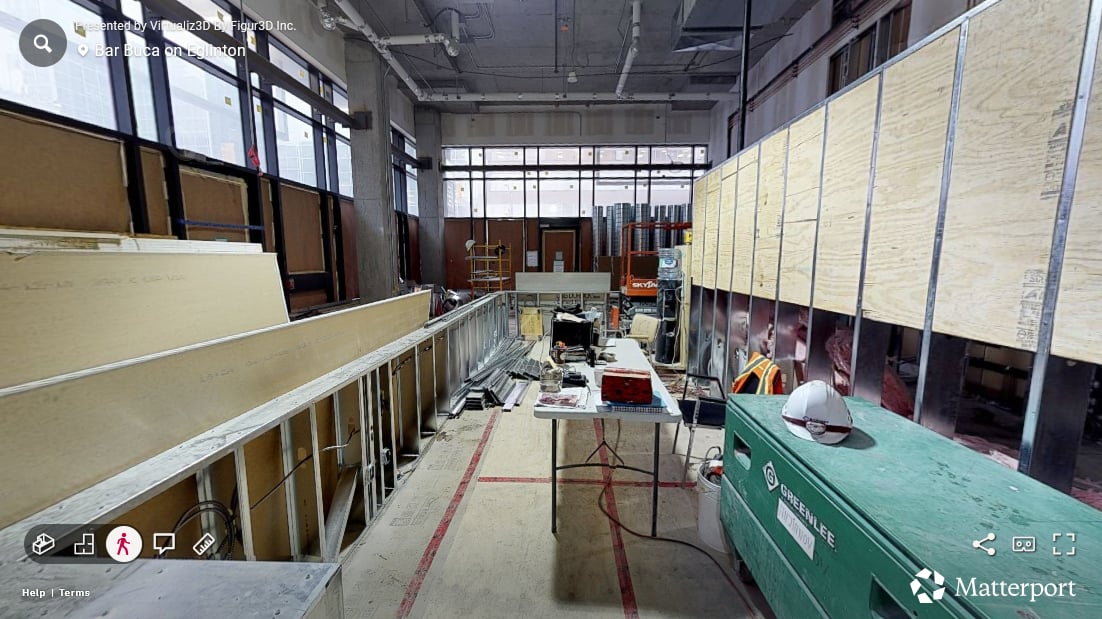
The first scan went in with framing up, services rough-in underway, and the bar layout staked out. Every mechanical run, stud bay, and chase visible at this point in the build is in the record.
Scan two — finishes going in
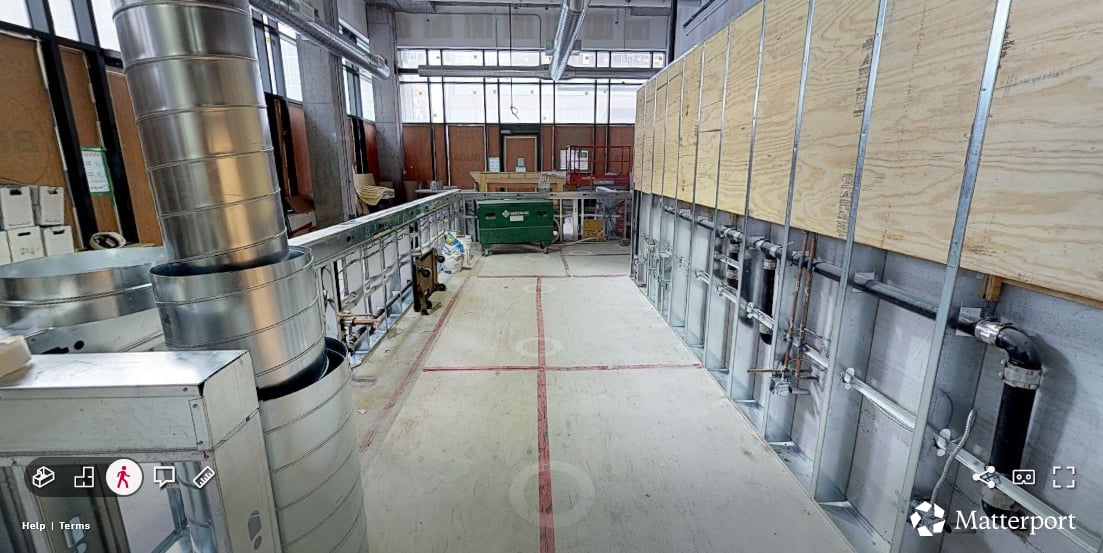
The second scan captured the same building after drywall and finishing surfaces went in. The same vantage points, transformed — letting stakeholders see exactly which decisions had landed since the previous scan.
Comparing the same rooms across both scans
The pair below shows the same view from the bar across both scans. Earlier capture on top, later capture below. Stakeholders abroad could pull both up side by side, compare progress at a glance, and know exactly what had changed without anyone narrating it for them.
Why this matters beyond Bar Buca
Absentee stakeholders aren’t unusual in commercial construction. They show up in:
- Multi-location franchise builds where ownership lives in a different region
- Investor-funded projects with capital partners abroad
- Family-office projects where the principals aren’t site-active
- Multi-shareholder restaurants and retail where some shareholders are passive
- Long-distance custom home builds where the future owner is relocating
In every case, scans replace the trip. Decisions stay fast because the people writing cheques can check rather than wait for a phone call.
See the case study
Walk the Bar Buca case study — both progress scans are embedded, plus the full set of paired room comparisons. The two scans together tell the build’s story without a narrator.
If you’re running a commercial fit-out for partners or shareholders who can’t visit the site, multi-phase progress scanning is the right tool. Get a quote or book a 15-minute call.
- #case-study
- #commercial
- #restaurant
- #progress-scanning
- #toronto
- #multi-phase